how do we know our paths are different?
lately, i have been thinking about a weird problem.
every morning when i leave my apartment to go to my office, the world presents three options in front of me. i can go straight from the gate, i can turn left, or i can turn right. each of these eventually branches into many possible ways of reaching my office.
usually i take a voi scooter. in that case, my objective is simple: minimize the commuting time because the scooter charges a flat rate per minute. after a few days of trial and error, you eventually figure out the optimal route. from that point onward, you simply repeat the same path every day to be cost-effective. it is efficient, but also incredibly boring because you end up seeing the exact same things every morning.
on top of that, my friends were quite disappointed in me for relying on the voi so much. they wanted me to walk instead and develop healthier habits. eventually, i was convinced and stopped using the scooter.
now i walk to work instead. it usually takes around fifteen minutes, although depending on the route it can be anywhere between ten and twenty-five minutes.
the interesting thing about walking is that the optimization problem disappears. most reasonable routes take roughly the same amount of time, which means i am free to explore. naturally, i started wondering whether i could intentionally rotate between different routes instead of unconsciously settling into another routine. i even thought about assigning routes to different days according to some quasi-periodic pattern so that i would never end up taking the exact same walk every day or week.
a few days later, i realized i could do the same thing while coming back from work.
part of this motivation actually came from an islamic tradition that the prophet would often take one route while going to the Eid prayer and a different one while returning. i find this behaviour fascinating from my childhood because it makes me feel a bit intentional about my mundane life choices.
naturally, my curiosity escalated over time and i started wondering how many different routes there actually are between my home and my office.
and guess what? i have no idea how to answer that question.
the problem was not counting routes. the problem was deciding what should count as a distinct route in the first place. before counting anything, i first needed a reasonably objective definition of what a ``different path'' actually means.
my initial intuition was something like the following.
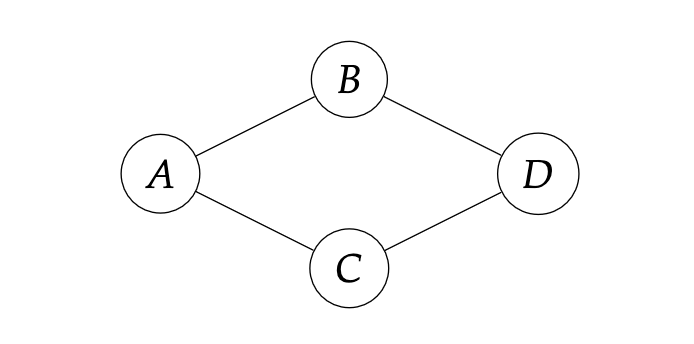
suppose, there is an intersection $A$, and from there we can reach another intersection $D$ through either $B$ or $C$. if both branches immediately merge back together without introducing any further choices, then intuitively they do not feel like genuinely different routes. they are simply two branches of the same larger path (see figure 1).
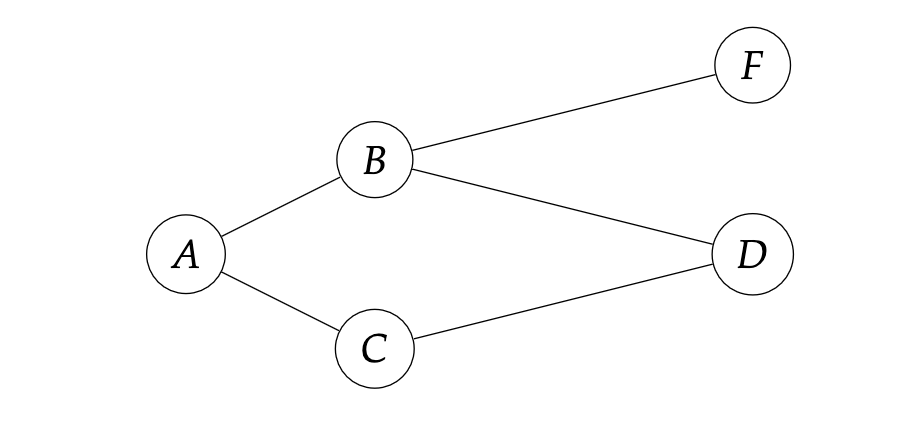
now suppose that while travelling through $B$, we encounter an intersection from which we could go somewhere other than $D$. suddenly, travelling through $B$ seems fundamentally different because it presents new future opportunities.
under this definition, a branch only becomes a genuinely different route if it introduces additional decision points. otherwise, it is merely a local variation of the same route (see figure 2).
at first, i thought this was a fairly elegant definition.
unfortunately, it completely falls apart in real life.
although it works in many situations, there are plenty of cases where people would clearly perceive two routes as different based on the visual experience even though the graph says otherwise.
imagine that branch $B$ passes through the university campus while branch $C$ follows the seaside. most people would immediately describe these as completely different routes despite the fact that they may reconnect shortly afterwards.
on the other hand, if the two branches separate for only fifty or a hundred metres before merging again, almost nobody feels that they have taken a genuinely different route.
even stranger, sometimes two roads remain separated for a long distance, yet they pass through almost identical residential neighbourhoods with similar buildings, trees and traffic. despite the large geometric separation, people still tend to feel that they are essentially walking the same route.
so the geometry alone is not enough. what we really need is some observable that objectively measures how different two routes actually are.
at some point, we even went back to the islamic tradition to see whether it could offer some clues. naturally, the scholars were not trying to formally define what constitutes a different route. instead, they discussed the wisdom behind the practice itself. there were four explanations but only the first one resonated with me personally and the other three seemed off.
according to this explanation, the prophet intentionally took different routes so that he could bless as many people as possible by passing through different parts of the community. of course, we are not prophets, and we cannot bless people in that sense. however, i think we can draw a broader metaphorical idea here that works for us. by taking different routes, you expose yourself to different people, different conversations, and different parts of your community. in a metaphorical sense, that exposure itself becomes a kind of blessing.
this led us to another possible criterion.
perhaps two routes should be considered different if they expose us to sufficiently different sets of people, especially people whom we would not normally encounter.
unfortunately, this definition also fails miserably upon scrutiny.
first, it is extremely culture dependent. it works much better in a close-knit society than in a highly individualistic one where people rarely know their neighbours.
second, it completely ignores the visual experience. a route can feel completely different even if you do not meet a single person, simply because its scenery has a distinct visual character.
finally, it is highly time dependent. i might meet one group of people today and a completely different group tomorrow while walking along the exact same streets. does the same physical route suddenly become a different route simply because today's pedestrians are different?
at this point, we are not really sure how to define a route in a way that captures the essence of human experience while still remaining reasonably objective.
one could always hard-code a threshold. for example, we could declare that if the visual signature of two routes differs by more than fifty percent, then they count as different routes.
but who decided that the threshold should be fifty percent?
more fundamentally, what even is a visual signature?
it depends on where you look, how long you look, the angle of observation, the weather, the season, the lighting conditions, and probably many other things that are difficult to formalize.
so the whole idea quickly becomes messy.
this brings me to the actual question that i wanna ask you.
in your own life, when do you feel that you are taking a different route from your usual one? what subconscious metric is your brain using?
more generally, is it possible to construct a mathematical model that captures what humans actually mean by ``taking a different route'' while preserving some degree of objectivity?
i genuinely do not know the answer, but it feels like an interesting question.